

An interview in a Chinese American Christian Church in San Francisco
31st of Aug 2006 – Cornerstone Evangelical Baptist Church
Janice and I went down to Cornerstone Evangelical Baptist Church at Silver Ave, San Francisco, California, to meet with two of Uncle Harry’s Chinese American friends – Alex and Philip. One should bear in mind that Cornerstone church is predominantly an Asian American Church with a close knitted, self sufficient Chinese American Christian community, with only one Caucasian pastor. It conducts its church services in Cantonese, Mandarin and English, and also has a school for children ranging from pre-school to high school. Since this interview will kick start our project here in the Bay Area, it gave us ground to prepare and polish up our questions for future interviews.
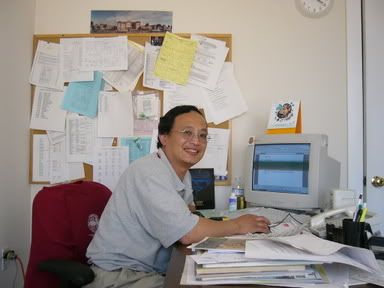
Alex at his office at Cornerstone Evangelical Baptist Church
We were introduced to Alex Sue in his office at the Cornerstone church, the first thing we noticed was a calendar with Chinese proverbs on the top of his computer. The rest of the office was filled with papers and timetables of Church activities.
Alex is a middle-aged Chinese American with a very jovial and vibrant personality and very much like a warm, fatherly figure. He came to America, from Hong Kong when he was 13 years old and has spent almost 30 years here in the Bay Area. Alex was previously an IT consultant before being retrenched during the 2001 burst of the dot.com bubble. Since then, he has been working as a church worker at the Cornerstone Evangelical Baptist Church in San Francisco. He now lives in Sunset District, another largely Chinese populated area in San Francisco.
As a teenager, Alex spent most of his time helping out at his father’s restaurant near Chinatown. At 20, his met his future wife, also an Chinese American from Hong Kong. It was then that he became a Christian and started attending the Cornerstone Baptist Church.
Having read most of the Chinese American literature on the kind of discrimination which Chinese Americans faced in America, it was interesting that Alex thought otherwise. While working as a senior IT consultant, Alex said that he rarely faced any discrimination as a Chinese American, and did not have a problem interacting with non-Asian American colleagues. When asked if he felt that his retrenchment was a result of racial bias, Alex believed that it wasn’t because the company cutback only left one other person in charge of the project and over 40 others were retrenched along with him. Although, Alex had a more varied multi-racial social circle in his previous occupation, his current job as a church worker in Cornerstone has altered his social circle. It now comprises of mainly Chinese-Americans, such as himself.
Could it be that being a Chinese American in the Bay Area is the norm rather than the exception? We also found out from Alex that Chinese festivals were widely celebrated around the Bay Area. Festivals such as Chinese New Year and the Mooncake Festivals are celebrated in schools and children are given the day off for Chinese New Year. Furthermore, Chinese New Year festivals in Chinatown are televised live on local Bay Area television stations, thus putting it on equal standing with other festive holidays such as Thanksgiving and the Fourth of July.
So how is life like for Alex as an American Chinese? Having spent 30 years in San Francisco, has this made him more a Chinese American or an American Chinese? Alex felt that he was first and foremost a Chinese, and proud of it. He feels strongly that as a parent of two teenage daughters, it is his duty to pass on his Chinese heritage and hope that they would accept them as his own. However, he also understands that they would never see things the same way as he does because they’re experience is essentially “American” and not “Chinese”. When asked if he would allow his daughters to date outside of their own race, he jokingly said that “hopefully Chinese, then maybe something else.”
At home, Alex is not only the man of the house but also the chef. He jokingly calls himself “yi jia zhi zhu”—pun on the “zhu’ (“cook” and “head”). He enjoys cooking Chinese cuisines and stresses that ‘the family must eat around the table during meal times’, rather than ‘around the television’. Does he still use his mother tongue, Cantonese, at home? He says that most of the time, he would converse with his wife in Cantonese and sometimes with his daughters. However, when we bumped into Alex and his younger daughter Jessica at a Chinese restaurant that evening, we observed that they were both conversing in English.
We also interviewed another member of the Cornerstone church, Philip. Being a 2nd generation Chinese America, Philip was more fluent in English and had a strong American accent. He has been working in Cornerstone church for over 20 years as a Media manager. He is married to a Chinese American and has two young daughters, aged 12 and 8.
(to be continued, approval pending)
------------
In Retrospect
Both Alex and Philip have very close interaction with the Chinese American Christian community and this has given them a comfortable environment in which to identify with many others such as themselves. However, being a generation apart, they share contrasting views of how they see themselves as Chinese living in America.
While Alex sees himself as a Chinese American and feels very strongly about being first and foremost a Chinese, Philip, on the other hand, sees himself as a American Chinese with no strong affinity with mainland China, yet he still feels a sense of belonging to his parent’s cultural heritage. In celebrating Chinese festivals, Alex seems to hold more importance to the event than Philip does. For Alex, the act of giving his daughters ‘lucky money’ (ang pao) and telling stories of how the mooncake festival originated helps in instilling in his children a sense of their cultural identity. However, for Philip, Chinese New Year is only celebrated with immediate family members, and not extended relatives (despite all his relatives being here in the Bay Area). He sees these festive occasions as a cultural routine adopted from his parents. Actually, although he claims that both Chinese New Year and Christmas were of similar importance, I would think that Christmas would play be of greater importance to him than Chinese New Year.
However, it is interesting to note that both seek to retain their cultural identity through language, and the practice of the language at home, especially with their children, is a conscious effort to preserve their cultural heritage.
Janice and I went down to Cornerstone Evangelical Baptist Church at Silver Ave, San Francisco, California, to meet with two of Uncle Harry’s Chinese American friends – Alex and Philip. One should bear in mind that Cornerstone church is predominantly an Asian American Church with a close knitted, self sufficient Chinese American Christian community, with only one Caucasian pastor. It conducts its church services in Cantonese, Mandarin and English, and also has a school for children ranging from pre-school to high school. Since this interview will kick start our project here in the Bay Area, it gave us ground to prepare and polish up our questions for future interviews.
Alex at his office at Cornerstone Evangelical Baptist Church
We were introduced to Alex Sue in his office at the Cornerstone church, the first thing we noticed was a calendar with Chinese proverbs on the top of his computer. The rest of the office was filled with papers and timetables of Church activities.
Alex is a middle-aged Chinese American with a very jovial and vibrant personality and very much like a warm, fatherly figure. He came to America, from Hong Kong when he was 13 years old and has spent almost 30 years here in the Bay Area. Alex was previously an IT consultant before being retrenched during the 2001 burst of the dot.com bubble. Since then, he has been working as a church worker at the Cornerstone Evangelical Baptist Church in San Francisco. He now lives in Sunset District, another largely Chinese populated area in San Francisco.
As a teenager, Alex spent most of his time helping out at his father’s restaurant near Chinatown. At 20, his met his future wife, also an Chinese American from Hong Kong. It was then that he became a Christian and started attending the Cornerstone Baptist Church.
Having read most of the Chinese American literature on the kind of discrimination which Chinese Americans faced in America, it was interesting that Alex thought otherwise. While working as a senior IT consultant, Alex said that he rarely faced any discrimination as a Chinese American, and did not have a problem interacting with non-Asian American colleagues. When asked if he felt that his retrenchment was a result of racial bias, Alex believed that it wasn’t because the company cutback only left one other person in charge of the project and over 40 others were retrenched along with him. Although, Alex had a more varied multi-racial social circle in his previous occupation, his current job as a church worker in Cornerstone has altered his social circle. It now comprises of mainly Chinese-Americans, such as himself.
Could it be that being a Chinese American in the Bay Area is the norm rather than the exception? We also found out from Alex that Chinese festivals were widely celebrated around the Bay Area. Festivals such as Chinese New Year and the Mooncake Festivals are celebrated in schools and children are given the day off for Chinese New Year. Furthermore, Chinese New Year festivals in Chinatown are televised live on local Bay Area television stations, thus putting it on equal standing with other festive holidays such as Thanksgiving and the Fourth of July.
So how is life like for Alex as an American Chinese? Having spent 30 years in San Francisco, has this made him more a Chinese American or an American Chinese? Alex felt that he was first and foremost a Chinese, and proud of it. He feels strongly that as a parent of two teenage daughters, it is his duty to pass on his Chinese heritage and hope that they would accept them as his own. However, he also understands that they would never see things the same way as he does because they’re experience is essentially “American” and not “Chinese”. When asked if he would allow his daughters to date outside of their own race, he jokingly said that “hopefully Chinese, then maybe something else.”
At home, Alex is not only the man of the house but also the chef. He jokingly calls himself “yi jia zhi zhu”—pun on the “zhu’ (“cook” and “head”). He enjoys cooking Chinese cuisines and stresses that ‘the family must eat around the table during meal times’, rather than ‘around the television’. Does he still use his mother tongue, Cantonese, at home? He says that most of the time, he would converse with his wife in Cantonese and sometimes with his daughters. However, when we bumped into Alex and his younger daughter Jessica at a Chinese restaurant that evening, we observed that they were both conversing in English.
We also interviewed another member of the Cornerstone church, Philip. Being a 2nd generation Chinese America, Philip was more fluent in English and had a strong American accent. He has been working in Cornerstone church for over 20 years as a Media manager. He is married to a Chinese American and has two young daughters, aged 12 and 8.
(to be continued, approval pending)
------------
In Retrospect
Both Alex and Philip have very close interaction with the Chinese American Christian community and this has given them a comfortable environment in which to identify with many others such as themselves. However, being a generation apart, they share contrasting views of how they see themselves as Chinese living in America.
While Alex sees himself as a Chinese American and feels very strongly about being first and foremost a Chinese, Philip, on the other hand, sees himself as a American Chinese with no strong affinity with mainland China, yet he still feels a sense of belonging to his parent’s cultural heritage. In celebrating Chinese festivals, Alex seems to hold more importance to the event than Philip does. For Alex, the act of giving his daughters ‘lucky money’ (ang pao) and telling stories of how the mooncake festival originated helps in instilling in his children a sense of their cultural identity. However, for Philip, Chinese New Year is only celebrated with immediate family members, and not extended relatives (despite all his relatives being here in the Bay Area). He sees these festive occasions as a cultural routine adopted from his parents. Actually, although he claims that both Chinese New Year and Christmas were of similar importance, I would think that Christmas would play be of greater importance to him than Chinese New Year.
However, it is interesting to note that both seek to retain their cultural identity through language, and the practice of the language at home, especially with their children, is a conscious effort to preserve their cultural heritage.
posted by Stuffy | 1:21 PM

1 Comments:
Hi Jan & Steph, great work and interesting stuff that involves us asians living in western worlds. It strikes me when reading your blog that do asians stand strong on our roots or do we sometimes bend over to western culture to be socially accepted. Anyways, keep up the good work and Jan, get me the 'got noodles' t-shirt please!
Foong :)
Post a Comment
<< Home