

When in Rome, do as the Romans do...
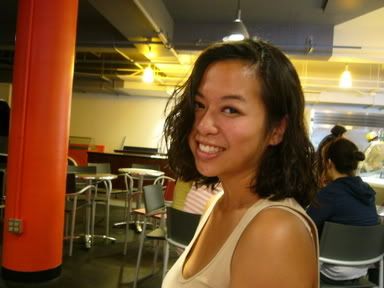
Beatrice
I was introduced to Beatrice by Janice who casually bumped into her on campus. Her mannerisms were wholly American and from our conversation with her, I could sense that it was a conscious effort on her part to assimilate into the American Culture, as opposed to Victor whom I met just that afternoon.
When asked what sort of jobs her parents held, Beatrice said that her father is a juvenile probation officer, while her mother is a kitchen designer. Beatrice herself pointed out that these were not the typical ‘Asian sort of jobs’ commonly held by most Chinese Americans. Given her atypical background, you get the sense that Beatrice isn’t your average Chinese American who feel very strongly about her cultural identity. In fact, she sees it as a non issue and believes more in assimilating into the new environment that her parents have chosen to settle into. It was through Beatrice that we came across the term ‘Fresh of the Boat’ (FOB) a nicknamed coined for Chinese Americans who refuse to assimilate into the American culture and have a strong cultural affinity to their Chinese heritage.
Steph
Below is a report by Janice on our interview with Beatrice:
Beatrice’s story
Background:
Beatrice’s dad works as a Juvenile probation officer and her mum is a kitchen and bath designer. Her parents live in Vallejo, her sister, alone in Concord, while she also lives independently in Pinole. Both her parents were living comfortably in Hong Kong but they decided to migrate to San Francisco mainly to explore the opportunities America holds for them and their children. Furthermore, Beatrice’s aunt who was already in San Francisco offered to sponsor her mum to come over. Beatrice came over when she was two years old and she’ll be going over to Hong Kong for an exchange in the spring.
On identity:
Beatrice finds it harder to identify with Asians because she has conflicting values after growing up around a very mixed environment. Having not grown up in Chinatown, she instantly accepted diversity and learned to distinguish individuals on a personal rather than a racial perceptive. Moreover her family has cut off connections with the others in Hong Kong. Hence, she only keeps in touch with her immediate and close family in the United States. Going back to Hong Kong for Beatrice would primarily be a tourist experience to learn more about the language and culture because for her, home is in Pinole (Although so close to SF, she still feels rather detached from the city.). Beatrice is aware of her indifference to the Chinese people but understands that although she does not use her race to identify herself, it is nonetheless still huge factory in her identity. Going back to Hong Kong would help her learn more of who she is, which is mainly a product of her parents. They serve as the medium in which she’ll learn of her people. She really wants to experience their youth, and although Hong Kong has gone through many transformations, the trip will give her a better understanding of their past. To restructure their lives in America was a huge sacrifice and struggle for her parents and she is very curious to see what they left behind and the influences that have shaped their current view on life. Re-establishing herself with her birthplace would also bring about greater understanding between her and other friends from Hong Kong.
She would only identify herself as a Chinese if asked but otherwise she hardly gives thought to her identity as to whether she’s American Chinese or Chinese American because most of the time she’ll introduce herself simply as Beatrice.
The Chinese in Beatrice brings out her competitiveness, the desire to achieve her ambition and display the practical side of her nature. Her American identity, however, is the creative end product after assimilating her Chinese heritage.
Beatrice introduces a new slang- FOB (fresh off the boat) which is a negative term used to describe Chinese Americans who generally don’t assimilate into the American society but rather try to retain their Chinese aura around them.
With the rise of modern China, she recognizes the economic value of being effectively bilingual and would grab the opportunity to highlight her Asian American identity as a smart career move. (Yes, to a degree. But, I feel one of my huge advantages is that although I am Asian and capable of speaking the language, I present a very different image, both in thought and physical body type. I would highlight my knowledge of the culture, but my identity would remain simply and indistinctively, Beatrice.)
On family and values:
Beatrice is very close to the family and she shares a very open relationship with her family. They can talk about almost everything and there is nothing to hide from her parents. Even if Beatrice were to find a Caucasian boyfriend, her family would not have violent objections because when they view an individual they are less bothered by his race or nationality and instead, are more interested in his personality. (However, they would still heavily caution her on the cultural conflicts that may later arise due to an inter-racial marriage.) Family plays a very influential role in Beatrice’s life because when compared to her American counterpart she feels that she consults and respect her family more.
On Food:
Beatrice enjoys Chinese food but it is not very often she gets that because both her parents are working and do not really have time to cook. (I don’t live with them, but when we get together for dinner once or twice a week, we will still have Chinese or Asian food, just not home-cooked, usually from a restaurant. On the daily basis, I am not skilled enough to cook many Asian dishes and am also away from home for most the day.) Moreover in San Francisco, there is a wide variety of good food ranging from Mexican to Italian, thus daily fanfare is not limited to Chinese food for Beatrice.
On language:
Both her parents speak Cantonese and sometimes in English to Beatrice. Most of the time, Beatrice converses in English with her sister.
On Chinatown and Chinese culture:
To Beatrice, Chinatown is just another tourist attraction and it’s mainly a ‘consumer experience’ over there. Though emotionally she might not feel much if Chinatown were to be demolished, rationally she would protest because she cannot find a legitimate reason to tear down what is a “symbolic tradition in California.”
She celebrates Chinese New year with her family but it’s mainly the immediate family. Beatrice does not listen to Chinese pop music but prefers American music and drama. Her dream is to be a singer somedayJ
Social Circle:
Beatrice has many friends and they are all of different races and nationality. She does not limit herself to Asian American friends but rather wants to interact and is open to friends whose values may differ significantly from her.
First glance at Beatrice, one is not really sure if she is a Chinese American as she has a nice golden tan and her style of dressing is that of a modern American lady. When talking to her I sense her dynamism and drive to work hard—vibes from most Chinese---yet there is something so American about Beatrice which I sort of find difficult to put a finger to. It could be the way she views certain issues or simply the manner in which she answers our questions---warm and helpful yet I can’t seem to identify with the Chinese in her. So perhaps for Beatrice, I would say she has assimilated well into the American society and for her, identity is about who she is now and where she’ll be in the future. Her past, roots and heritage is but a past, it’s a small part of her life though certain aspects like the importance of family would continue to follow her through the rest of her life.
Janice
posted by Stuffy | 4:37 PM

0 Comments:
Post a Comment
<< Home