Chinese American or American Chinese

Sunday, September 24, 2006

Dear Janice,

Hope you’re back safely in Singapore, I’ve posted our structure of the report below, or course subject to change. Will see you back in UK, email me on any changes.

Steph

Main title:
An Inquiry into the Chinese American Identity in the Bay Area

Date: 29th Aug 2006 – 22nd Sept 2006

Introduction:
• Why we decide to do this project
• What is the purpose/objective of the project
• Who is intended for, and why we think it is beneficial for them
• Why we chose to do it in the Bay Area (defining the boundaries of the project) and why we decide only on mainland Chinese and Hong Kong in the interviews (definition) – geopolitical entity, culture, Singapore experience
• How we categorize first and subsequent generations. `


History of the Chinese in the Bay Area
Etc..

Methodology
• Methodology means the methods used to fulfill/achieve our objectives of the project
• Qualitative methods
• Why did we choose these methods and not other things?
Background reading
Interviews: 45mins to 1.5 hrs (tape recorded interviews, video recordings)
Photography
Experience: dinner, objects, houses visits
Excursion: Chinatown, Angel Island, Silicon Valley, Museums, Library, Berkeley Campus, CHKA organization meeting, Sunset District, Pacific East Mall

Limitations and what we would have done differently
1. Problems with getting group interviews
2. Perspective of other races looking at the Chinese American
3. Skewed towards students from UC Berkeley because we have the most connection with,
4. Focus of the interview. Interview was not structured? The interviews were a learning process in itself and each interview was evolved into a more structure manner, hence cannot be taken to be a standard template used across all interviewees. Why is this a problem, but how we learnt from it.
5. Conversational nature of each interview – Merits and limitations
6. We were caught up with the ambiguity of the English language on what it means to be Chinese.
7. Some interviews were not tape recorded because of technical faults.
8. Unable to find those who spoke no Mandarin/Cantonese – hence given more time, we would have interviewed other ABCs who spoke no mandarin and ask if you can be a Chinese without knowing the language at all.
9. Respect for the elder generation
10. No photography of certain houses because of interviewee disapproval.


Analysis:

Structure for Analysis ( points below are collated under these headings)
1. Does my future lie in America or China? (Citizenship)
2. Preservation of Heritage
a. Parents – see homes, interviews
b. language
c. Family – see interviews
d. Living Chinatown
e. A forgotten heritage – Angel Island
f. Loss of Heritage
3. Avenues of assimilation at present
4. False Identities and Imagined Communities
5. Beneath the Stereotype

Sample size: 20 Interviewees
American-born Chinese:
• Christine
• Philip
• Jessica
• Victor
• Jenny (LA)
• Alice (White, Indiana)
• Emma

2nd Generation Chinese Americans (came in their early childhood)
• Beatrice (SF)
• Linda Lu
• Linda Chen
• Serena Wang
• Hua
• Mike (came when he was 13)
• Alex
• Nicole
• Yip Hei Ming

1st Generation
• Lei qi
• Karen
• Ye Zhou
• Chen Jian Long

2nd Generation
• One group says that they see themselves going back to China as tourist but not living there – ( Alex, Philip, Jessica, Victor, Linda Lu, Alice, Christine)
One group says that they see themselves shuttling between China and America or potential going back if there is a job – (Nicole, Jenny, Beatrice, Linda Chen, Serena Wang, Hei Ming, Hua)
• Being a bridge across China and America (culture, assimilating new immigrants)
• Language – the ability to speak Chinese fluently how comfortable they were with they’re Chinese Identity. Language determined how readily they identified themselves/ associate themselves as Chinese.
All parents made a conscious effort to impart the Chinese language to their children when they were young, a conscious effort to preserve they’re cultural heritage.
• Location – helped to preserve the Chinese heritage. Because of the growing number, it reduced the Chinese American Identity conflict that so dramatically played up in the Joy Luck Club. Most of the interviewees did not give a second thought to they’re identity and did not see it as a crisis or extreme conflict. In fact they never thought of whether there was anything conflicting between being a Chinese American.
• A lot of avenues to Chinese heritage, which is taken for granted (Supermarkets, festivals, holidays, library books, community of support) – deeper exploration of Chinatown
• Does it make you less Chinese if you did not adhere to the Chinese traditions? i.e.: using chopsticks, or not speaking the language. What happens if you were to contrast yourself to foreigners who adhere to these Chinese traditions, as oppose to yourself. – personal reflection on Peranakan.
• Dressing makes a difference
• Is it your own blood that makes you what others perceive you to be.
• What makes you authentic?
• Does having an American passport make you American?
• Confused Identities, when do they take what Identity?
• Dilution of culture and loss of authenticity: Lack of dissemination of culture ( Emma, Victor)
• Multiple Identities and False Identities – psychological. Loss of information because of the fear that others will discover, and partial embarrassment. (Victor)
• Imagined communities: once you leave SF you tend to be alienated. (Alex, Victor)
• False Identity of being an American and Imagined community. (location, employment glass ceiling, political realm).
• Mass Exodus to Silicon Valley (economic realm).
• Diaspora within Diaspora
• Categories of Chinese – location, language and customs, looks
• More Chinese: exposure and social interaction (what you do to keep in touch with Chinese culture)
• Does language come first or appearance come first – biological
• Historical and Cultural context : disprove the hypothesis that the cultural gap is not only a result of historical and cultural context, but it is further widened by the ‘loss of information’ handed down from one generation to another.
• Interview: effort to make them think about their identity – personal reflections for Janice.
• Cause for assimilation: Melting pot and Salad bowl theory
• Social aspect of America (Hua, Jenny,
• Family as a integral part of the Chinese culture: importance of family
• Stereotype, Amy Tan and her book, whether the book was true reflection of Chinese Americans. What is they’re opinion of the Chinese American stereotype, how would they like to portray themselves as Chinese Americans.

First Generation
• Reason why they left China (关系, economic opportunities, American dream, the American institution)Are these the same reasons as those of their forefathers who left 2 centuries ago.
• Previous generations coming: Most of them came because of family ties.
• The American dream: whether this is a reality for them is a different thing altogether.
• Link it back to Does my future lie in China or America (1931)
• Comfort ability with the Chinese language
• Parent-Child gap, and how they view they’re children in the future and how they would like to bring up their children. It is an acceptance on they’re part to compromise. (Ye Zhou, Lei Qi) i.e.: teaching the Chinese language
• Professional identity
• Contrast between work ethics of Chinese and the others. (i.e.: reserve about politics because they have different train of thought) – contrast with the 2nd generation/ ABCs, that they are more politically involved.
• The passive nature of the Chinese
• Glass ceiling in the work place
• Mass exodus into Silicon Family
• Having the family in mind, their specific purpose to make money and are therefore not readily involve in politics. (Link to family)

Chinatown:
• Underside of the Chinese community Street community/Tongs, Chinese Playground
• Living Chinatown: Closely knit network among the Chinese living in Chinatown because of the people that Victor knew
• Chinatown represented one part of China, Southern China/ Cantonese. (Karen)
• Chinatown SF more culturally contained. as oppose to NY, LA Chinatown. (Jenny, Hua). More isolated, culturally contained, not exactly adaptable.
• East-West influence, unique to the Chinese American culture is also present (churches and temples, the Luck and Jessica’s Dad doing Qing Ming Jie)
• How everything co-exist, unspoken harmony. Coexisting of vice and virtues (i.e.: Portsmouth, Chinese Playground, Mah Jong at Hang Ah Alley) – a society of their own, isolated community. (Imagined community or distinct community: Tangible and Intangible)
• How Living the Chinatown is – dirt, schooling, buying from the market and the sights and sounds
• Basis of comparison is with Singapore Chinatown
• Struggle a balance between the western influences coming in, and preserving its own heritage. But has it done well in preserving its heritage or has its heritage been diluted by Western influence
• You can’t get a cultural experience visiting Chinatown, but a more historal experience. Chinatown as a sanctuary with no evolution and cannot be reflective of a modernizing China. None of the interviewee said that Chinatown reminded them of home.
• Identity of the Chinese American from a particular period

Angel Island – the forgotten Island
• Emma and False Identity
• Victor and Emma’s similarity and conversation
• Angel and Alice Island
• Was coming to America worth it? Relate to the first generation, was it worth giving up the Chinese Identity? How much you would want to sacrifice for the American Dream
• More avenues for assimilation for the new Chinese immigrants because of the new legislations and policies (trial and error) which accommodate the large Chinese population living the Bay Area (road signs both in English and Mandarin and Sunset District, Richmond)
• Vested interest of Emma in discovering her Chinese American Identity and contain a rich of history of lot of neglect.
• Embarrassment for the people who were kept at Angel Island. (refer to poetry about a sense of injustice and historical embarrassment, Brother’s sense of jail in Angel island) ‘Lost of Face’, ‘Want of Face’ – loss of information.
• Funerals – secrets to the grave
• Angel Island Vs Chinatown

Palo Alto and SF Comparison

• Demographics was different (1st generation movement towards Palo Alto, white collar vs blue collar)
• Dynamism and vibrancy
• Multicultural
• See Bay Bridge newspaper
• ‘High Tech Low Tech’
• Northern China (family)
• Mobile, touch and go. Not as many racial issues as oppose to SF. Not as historical.
• Economics overshadows politics and racial issues
• More risk taking spirit
• Comfortable in assimilation.
• Everyone has a purpose in PA, and that is to make money
• SF Palo Alto comparison, wealth vs race

Houses
Alex: (Sunset District) 2nd generation
• Chinese Calendar and the Kitchen utensils were very Chinese
• Language
• Table manners
• Cantonese TV
• Jessica’s room: expressions of Chinese Identity
• More westernized
Victor’s place: 1st generation home
• Typical blue collar worker
• Chest, luggage, pictures of their ancestors.
• Play station and infiltration of Western culture – generation gap
• Respect for elders
• Dorm consistency

Vincent’s house, silicon Valley:
• Cooking utensils gave it away
• Different lifestyle from the other two houses, i.e.: artifacts
• Hei Ming helped to set table
• Responsibility of the elder son
• Compromise on the parents part by having the Confucius sayings written in English

• Forming of the Chinese American Identity in the house
• A lens into the present era of the Chinese American

Tuesday, September 19, 2006

As a 桥 between both China and America

Photobucket - Video and Image Hosting

Nicole was born in Hong Kong and moved to the LA when she was about two. She has been residing in Sunset District in San Francisco since 1989. Her parents are now separated and she lives with her mother and grandmother.

When Nicole was asked whether she could identify the elements which were ‘Chinese’ in her and the elements which were ‘American’ in her, Nicole attributes much of her Chinese influence from her upbringing. She was taken care of by her grandmother who instilled in her Chinese values and traditions such as celebrating Chinese festivals and respect for elders. Like most Chinese families, the emphasis was also on studying hard at school. Furthermore, Nicole feels more incline to follow Asian fashion and keep up with Hong Kong and Chinese serial dramas

At home, she speaks Cantonese “at least 90% of the time”, and feels comfortable with the language because “sometimes, there are things that I can express better in Cantonese than in English”. Does she also use Cantonese among her friends? Nicole uses English a lot more among her friends, especially because some of her friends are non-Chinese Americans or American-born Chinese who could not speak the language.

So what does going back to Hong Kong feels like for her? Now that she is much older, she appreciates going back to Hong Kong more often and does not see herself as a tourist. Nicole goes back almost every year to visit her father who resides there. She says that her father “demands that she goes back to Hong Kong every year to see my (her) elders, and keep in touch with family members”. Thus, she “can fit in” naturally back in Hong Kong, and enjoys the “Asian nightlife and style” a lot more.

When asked if she could see herself residing back there, Nicole was hesitant and did say she would think twice about it because majority of her friends are in America. However, she can see herself shuttling back and forth between the two countries, “kind of like working there and traveling back and forth”. After all, “China is now a major economic power” and she does see it as an opportunity to find a good job in Hong Kong. Hence, as a Chinese American, Nicole sees herself like uniquely as a bridge ( 桥)between both China and America

When asked whether she was more of a Chinese American than an American Chinese, Nicole said she sees herself more of as a Chinese American because the values which she hold are very much “still Chinese in nature”. Her frequent use of Cantonese and adherence to Chinese traditions such as celebrating Chinese festivals and practicing table manners, the Chinese way, make her still very much a Chinese who happens to be “living in America”.

Monday, September 18, 2006

Just a quick note on Palo Alto:

Closing the San Francisco Chinatown chapter and moving on to Palo Alto has given us some interesting insights. We met up with Vicent and family the night before and interviewed his 16 year old son and Shanghai-nese wife (Vicent is a ex Singaporean diplomat during the LKY administration and now resides in Palo Alto).

Bunked in for the night at Chin San's place and conducted 3 interviews the next day. Special thanks to Chin San and his housemates, all of whom have been extremely hospitable, Janice and I cannot thank you enough.

A few things to note about the three interviews we had:
a) All of whom were working adults and 1st generation immigrants from China
b) None of which were from Guan Zhou or Toishan (the bulk of whom we inevitably kept bumping into in SF and Berkeley)
c) While one is applying for an American citizenship, the other 2 are holding onto a green card and are unsure of getting an American citizenship
d) All felt more comfortable having the interview conducted in Mandarin
e) Age ranged from 30s - 40s, all have American born Children
f) Occupation wise: All are working in companies around Silicon Valley, one is a researcher, the other two are engineers.
g) All have lived in the Bay Area for the last 10 years.
h) All cited the lack of '关系’in China which lead them to find work here in the Bay Area.

A few observations:
* There is a remarkable difference between the Palo Alto crowd and the San Francisco crowd in terms of type of people we interviewed as well as they're opinions.
* It was quite difficult to find fresh of the boat immigrants in SF as oppose to Palo Alto. I cite the article from the San Francisco Chronicle: Bay Bridge to Beijing which cites Palo Alto as the new Golden Mountain, AND Iris Chang's Chinese in America, Chapter on 'High Tech and Low Tech' which talks about the movement of Chinese immigrants into Palo Alto.
* Since Janice read Iris Chang's chapter on High Tech Low Tech' before the interviews, while I read it only after, we went into the interviews with very different perceptions. However, the difference between SF and PA are extremely evident even without prior knowledge of academic material.

There are alot of material which I'm still consolidating for the Palo Alto phase, but comparisons will become alot clearer in answering the question of 'Why is there a Diaspora within a Diaspora'. This will also tie in with our objective in finding out the multi-faceted identities of the Chinese Americans.

I just visited the Ethnic Library to get some books from Victor who works there,
1. Bridging the Pacific (SF Chinatown and its People)
2. Songs of Gold Mountain - to compare with Mr Luo's anthem

Till then,
Steph

Saturday, September 16, 2006

骨肉情深 最难忘 (The most difficult thing to forget is that blood relations run deep)

Mr Luo’s anthem, which he wrote for the anniversary of the table tennis team in December 2003 is a poignant reflection of what most of the first generation Chinese immigrants hope for.

While they celebrate a new life in America with opportunities for wealth and prosperity, there is also a deep-rooted allegiance to their country of origin and a longing that one day they may return back home and make their country proud of their achievements. Like most Chinese immigrants, the new life comes with the need to work hard and perseverance, hence, the constant reminder to the youths to study hard, for studying hard will bring about a brighter future ahead. There is also a reminder for the younger generation to remember what their parents have done for them – they have worked hard and brought them up in a new land to provide for them a better life.

The title: 骨肉情深 最难忘 expresses something that I’ve been trying to find out through the last three weeks. 其实, 你已经不是 一位中国人民, 但是你还是一位华人。 I think most of the interviews that we have had so far, regardless of which generation of Chinese Americans, all of them have said the same thing – they are first and foremost Chinese, but they are American. I think it became clearer in the interviews conducted in Mandarin what it means to be ‘Chinese’ and yet not American.

I was reading a chapter of Iris Chang’s book: The Chinese In America, which argues that the Chinese Americans are still regarded as being closely affiliated to the People’s Republic of China, ‘no matter how great their contribution to U.S society, virtually all of them have had their identities questioned at one point or another’ (Chang, p13). I spoke to Janice earlier about this, and the topic was raised on two occasions; the first, was a conversation with an ex-Singaporean diplomat living in Palo Alto, and another in our interview with a first generation Chinese working in Silicon Valley.

The problem with the word ‘Chinese’ in the English language creates much ambiguity because ‘Chinese’ is used to describe someone of Chinese ethnicity, but at the same time, that very word is also used to describe someone of Chinese nationality. When we mention loosely that a person is ‘Chinese’, it almost becomes inevitable to assume that such as person has some form of affiliation with the country where the Chinese tradition ad culture has originated from. Hence, the common misperception that the phrase ‘I’m Chinese’ tends to have connotations that the person has affiliations with China. In the Chinese language, however, there is a distinct definition between a person who is of Chinese ethnicity (华人) and a person who is of Chinese nationality from the People’s Republic of China (中国人民). In 华人, the character ‘化’ expresses a people of rich culture and tradition, where as , 中国人民 has no relation or root word whatsoever to 华人, and 中国 (China) refers instead to what China was originally called, the Middle Kingdom.

I’ve translated the song in English for the benefit of the Lord Rootes Memorial Fund archive, the following is a loose translation of the song, which is subjected to correction once I get hold of my Mandarin Dictionary.

骨肉情深 最难忘

人生什么 最难忘 骨肉情深 最难忘
人生什么 最重要 保养好身件 最重要
读书 为 的是什么 读书 为 事业 为前途
多 少数的守候 多少辛筋的关爱
人生什么 最快乐歌唱我们的新生活

海外的亲人常思念,唉咳喻。。。 终于回到自己的守园

强身健体要坚持,唉咳喻。。。身体强健才 有夺钱
筋学苦练为自己,唉咳喻。。。 前途光明才有出息
养育着你们步步的成长,唉咳喻。。。是爸 妈恩情忘不了
祝愿 早日完成祖国 一大业,唉咳喻。。。 祝庆我们全部欢聚在一堂


“为献上我对会周年庆祝 而欢呼歌唱吧!”
罗威


What is the hardest thing for one to forget? The hardest thing to forget is one’s own blood relations which run deep.
What is the most important thing for a person? The most important thing for a person is to take care of one’s health
What purpose is there to study? Studying is for ambition and for future
No matter how much waiting and upholding your dreams, no matter how much perseverance and love,
What is one’s happiest moment? To sing a song about our new life.

Overseas people always dream, always about returning to one’s own sanctuary (or home, which in this case refers to mainland China).
A strong health must, only if one’s health is strong can one have wealth
Persevering hard in one’s studies is for one’s own good, only then can one’s bright future be possible
To bring you up step by step is your father and mother’s responsibility which cannot be forgotten.


Steph

Friday, September 15, 2006

Hang Ah Alley and 'Chinese Playground: A Memoir'

Photobucket - Video and Image Hosting
Hang Ah Alley

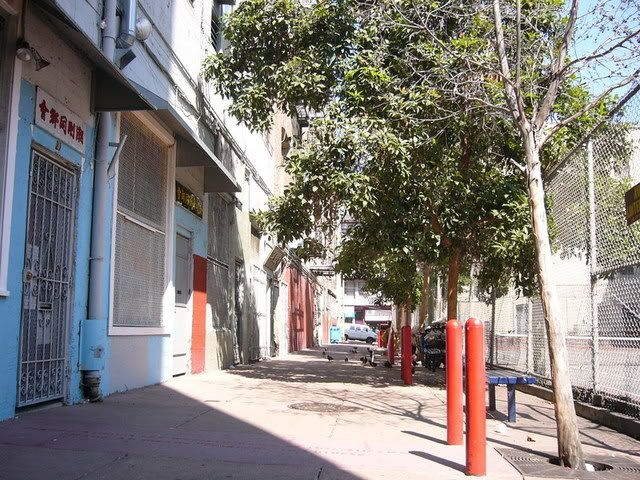
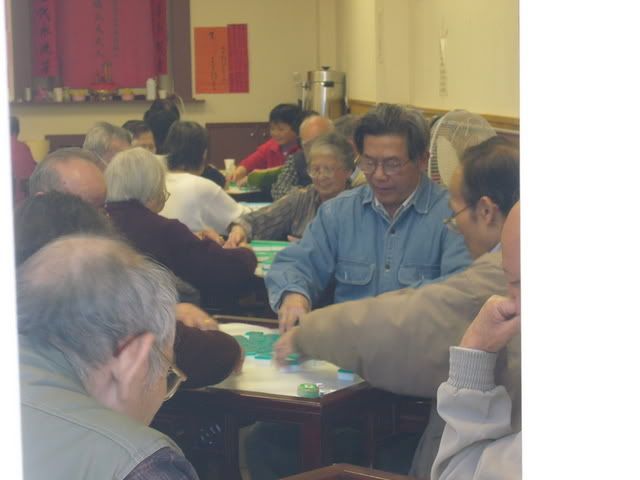
Janice and I spent Thursday mid-morning walking around Hang Ah Alley which is next to the Chinese Playground. Although the Alley was not crowded with people, we could hear the sound of Mah Jong tiles coming from the Benevolent Family Associations situated on the side of the Alley opposite the Chinese Playground. Peeking through half open doors, I saw the older folks playing Mah Jong in all three benevolent associations.

Photobucket - Video and Image Hosting
Older folks playing mahjong at the Wong Han Benevolent Association

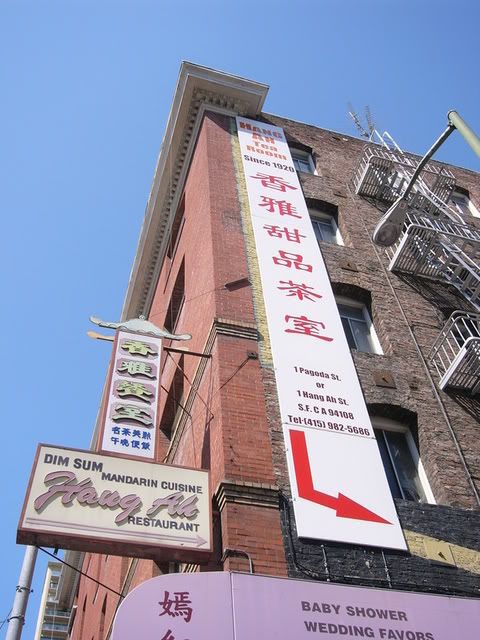
We stopped for a light snack at the Hang Ah Tea Room, which claimed to be the oldest place in Chinatown selling dim sum. Having much publicity from travel guide books and travel agents, the Hang Ah Tea Room has turned into a tourist attraction and a place where the Chinese brought business associates. This was probably a place where a local would never step in for a meal, and the crowd in the Tea Room was comprised of foreigners or Chinese with foreign business associates.

Photobucket - Video and Image Hosting
Outside the Hang Ah Tea Room

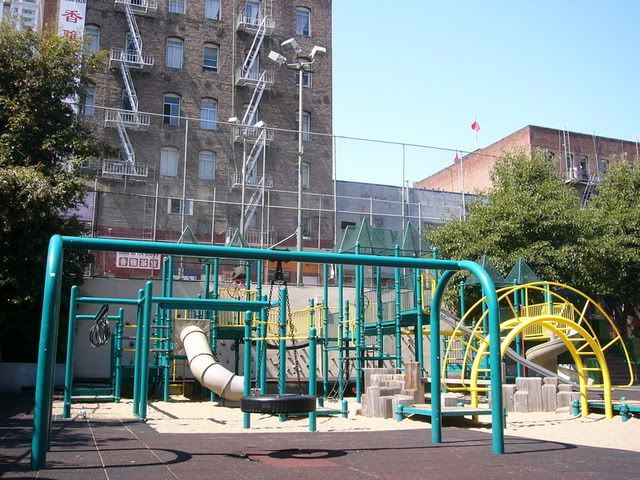
After a light dim sum, we returned to the Chinese Playground which Victor had brought us to last week for a quick visit of the place. I remembered that I didn’t have much of an impression of the playground, just that it was a place for recreation and where parents brought their children to play during the weekends. The official inscription pinned on the building where Hang Ah Alley was read:

Hang Ah Alley
The Chinese Playground is one of the few recreational facilities in Chinatown. In order to make use of as much open space as possible, the Committee for Better Parks and Recreation in Chinatown and the San Francisco Department of Parks and Recreation worked for 11 years on new plans for the playground. The old club house was torn down in June of 1977 and the new structures were installed 3 years later. Mr Oliver C. Chang was the first director of the Chinese playground as well as the first Chinese American director of the SF Department of Park and Recreation.


The Chinese Playground for me has taken on a different meaning after reading more into the Chinese street gangs and picking up the book ‘Chinese Playground: A Memoir’, written by a Chiense ex-gang member, Bill Lee. As a tourist, one would have never suspected that the Chinese Playground reflected both the wholesome and the underlying social ills of the Chinese community, especially during the 1960s and 1970s.

Photobucket - Video and Image Hosting
The Chinese Playground after the 1977 refurbishment, also known as the Willy 'Woo Woo' Wong Playground

“The city of San Francisco purchased the land in 1925 and completed construction in 1927. The playground was situated with Waverly Alley to the east, Hang Ah Alley to the west and Clay and Sacramento streets as its north and south borders, respectively. There were three levels within the grounds. A basketball court was on the lower level, and a tennis and volleyball court were in the upper section. Everything was out in the open. A small clubhouse with a pagoda design stood on the main level along with a slide, swings, merry-go-round, and ring apparatus.

I spent countless hours playing ping pong on a table that was bolted to the ground in front of the clubhouse. Every few years, they’d slap a new table-top on. Behind the building sat a mini-slide and concrete sandbox where we transported water for our muddy-duddy creations. There were three ways to enter and exit the park: from the two alleys and on Sacramento Street. The multiple accesses served us well as children playing hide-and-seek. The playground was our home base and we hid throughout Chinatown.

As a young boy, I was chased by the police in one entrance and out the other over illegal fireworks sales or other petty crimes.

The first gang of immigrant kids, the Wah Chings, originated out of this playground in 1964, complete with club jackets. They discreetly came in ad out through Waverly Alley and congregated in the basketball court that they used for soccer. Every Sunday afternoon, an organized volleyball game was played in which gang members participated with others from their homeland.

The gang wars from the late sixties to the late seventies turned the playground into a hot spot. It symbolized the ruling gang in Chinatown, and opposing sides ambushed one another at all entrances. Chinese Playground was a second home to me from the time I was a toddler. Just half a block from our house, it was reached by crossing one intersection to Hang Ah Alley. Kids gathered there early in the day on weekends, holidays, and during the summer. We also played in alley ways, jumped on and off moving cable cars and hung around department stores downtown. But at the end of each day, we regrouped at the playground.”

Having an understanding of how Tongs work in the Chinese American community is crucial. Chinese gangs (Tongs) are part and parcel of the Chinese American Community in San Francisco. Much of the newspaper cuttings which we read from the San Francisco Chronicle about the recent gang violence and shootings seem to suggest that the underside of the Chinese American Community living in San Francisco have to grapple with. Although gang activities are not as rampant as they were in the 1970s, much of the Chinese American community today speaks little of the topic for fear of retaliation by these gang members. In this book, street gangs do recruit members from the recreational areas, thus park directors cannot be caught off guard and it was part of their everyday job to have to interact with teenage gang youth. Thus, park directors were held in high regards and as Lee puts it, “most of the kids who hung out at the playground spent more time with Paul (the site director at that time) than with their own parents. He was firm, yet highly skilled in diplomacy, earning respect from fei jies (gangsters) who were fearless).”

In Lee’s opinion, the playground “wasn’t a conducive place for any child to be in. Adults who chaperoned their children there enjoyed the facility as it was intended. But it was, for the most part, comprised of kids from troubled homes thrown together unsupervised. Paul (the site director) was a good influence, but he was one person. Junior sociopaths outnumbered him twenty to one.

We didn’t develop the right social skills at Chinese Playground. The environment represented the dark side. We learned to cheat and lie. What you could get away with prevailed over fair play. It was ‘screw the other guy first’ and ‘you don’t let anyone fuck with you’.”


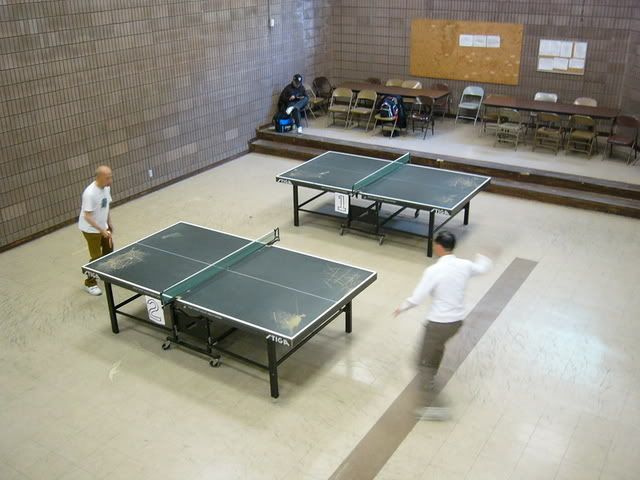
Nevertheless, street gangs are less prevalent in the playground after its refurbishment in 1977. When Janice and I were in the playground that morning, we came across a group of old Chinese men who were playing table tennis. We met with Mr Luo, 75. We introduced ourselves as Singaporeans, and he said that he and LKY were from the same province. He told us that he was a table tennis coach who coached in the Chinese Playground and that his whole family was here in the bay Area.

Photobucket - Video and Image Hosting
Inside the Chinese playground clubhouse, old men playing table tennis

Photobucket - Video and Image Hosting
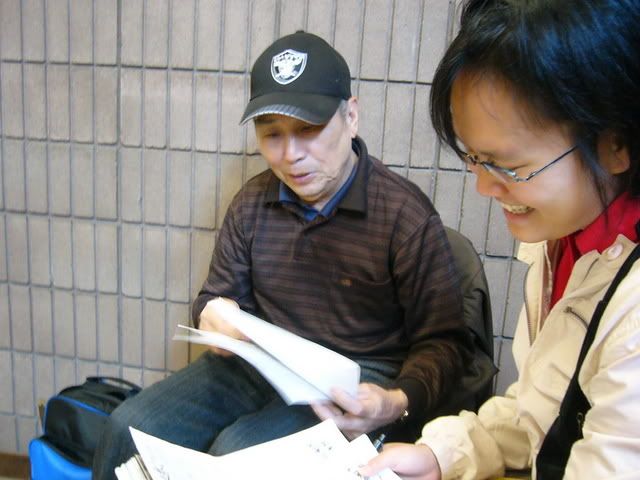
Janice and Mr Luo


Mr Luo showed us some of his photos of his family. Being a table tennis coach, he told us that he wrote a sports anthem which he used for his team during competitions. The anthem:

人生什么 最难忘 骨肉情深 最难忘
人生什么 最重要 保养好身件 最重要
读书 为 的是什么 读书 为 事业 为前途
多 少数的守候 多少辛筋的关爱
人生什么 最快乐歌唱我们的新生活

海外的亲人常思念,唉咳喻。。。 终于回到自己的守园

强身健体要坚持,唉咳喻。。。身体强健才 有夺钱
筋学苦练为自己,唉咳喻。。。 前途光明才有出息
养育着你们步步的成长,唉咳喻。。。是爸 妈恩情忘不了
祝愿 早日完成祖国 一大业,唉咳喻。。。 祝庆我们全部欢聚在一堂


为献上我对会周年庆祝 而欢呼歌唱吧!

罗威


Hang Ah Alley, written by Steph

Tuesday, September 12, 2006

Christine's story

Victor first introduced us to Christine when we bumped into them in Chinatown. Sensing that both Christine and Victor were very different, I jumped at the opportunity and was really elated when Christine agreed to our interview.


Background

Christine was born in Chinatown, San Francisco and is now living in Daly City. She has two older brothers who are in their thirties which makes Christine the ‘baby of the family’. She considers herself 2nd generation Chinese American because she was born and raised in America.

On identity


According to Christine, ‘logically I am Chinese American because I was born here but I still retain some of my cultural ideals and values, though I believe that I am Americanized’.

The Chinese side

She celebrates Chinese New Year and speaks to her family in the “Toi San” dialect. Family is very important to Christine and one of the reasons she chose Berkeley, other than its reputation, was to be close to her family so that she can still return back during the weekends to ‘yam cha’ with her grandmother.

The American side

She cannot conform to the Stereotypical portrayal of Chinese women. Sometimes her parents would ask her to be more ‘like a women’ to ‘cook, do your own laundry’ but Christine cannot perceive herself as the submissive Chinese women. There is the competitive American side of Christine where she wants to be the best she can be, and not let gender limit her opportunities. She could relate to joy luck club because of the generation gap portrayed. Though her parents are in general supportive, her mum’s desire for her is to ‘marry a good men’. However, for someone like Christine who is so dynamic and bright, I seriously doubt she would ever content with the role of a docile ‘tai tai’ (‘rich man wife’ )

On multiple identities

Christine first and fore most identify herself as an American. It is only upon other people’s initiation that she would bring up her Chinese identity. Growing up as a Chinese American, Christine did not face significant difficulties except for her high school years. She regrets how sometimes she would play into the stereotype of the smart but passive Chinese student. In retrospect, she feels that there is so much more to her than that, which her friends in high school back then were not able to understand.
Unlike some of our other interviewees, Christine does not perceive herself to be a ‘qiao’ between China and America. She does not foresee herself shuttling between both countries because for Christine, America is where is she grew up, where she has her contacts and there is definitely “more opportunities in America”

Sociological perspective on identity

Perhaps because of her sociological background, Christine appears to be someone who has given thoughts to issue of identity. She was well informed and aware of academic terms like ‘model minority’ and her sharing of the importance of issues like identity really gave us encouragement to continue our cause.

Researching on identity is challenging because there would always be questions on our methodology. How do we strike a balance between randomness of the sample yet simultaneously be able to spot and infer some trend? Nevertheless, Christine also feels that sometimes the process is as important as the outcome. By thinking about complex issues like identity, one can learn more about his/her background and this academic venture could help shed light on other matters like model minority. To come up with an alternative perspective and in the process find means of coping with it is how we can value-add to our project.


Janice

Sunday, September 10, 2006

Pit Stop: Reflections

6 September: Pit Stop

What went well for our project

· Diverse perspective as a result from random sample
· New perspective on Amy Tan--- She is writing for a ‘white audience’ and that ‘joy luck club is an exaggeration and over dramatized’
· Learnt slang “ FOB-Fresh Of the Boat”. Term used to describe first generation Chinese American immigrant who have just arrived. Today used to describe American born Chinese who are very Chinese in their dressing and behavior.
· Met “FoBs” and some who appreciate and are proud to be one
· Discovered the difficulties of trying to categorize people. We were trying to group and find trends/ similarities across our interviewees. Perhaps social science is not about trying to generalize too much, but rather at this stage we just have to continue getting building blocks
· We’ve been reflecting diligently. It takes up a lot more time but hopefully through this reflection process we can enhance our learning curve.
· First-hand experience of the dichotomy between reading materials and reality. The meaning of “ Chinese Playground” both in the academic field and in Chinatown
· Personal growth
Janice ---learnt to be more discerning
Stephanie---learnt to be a better listener
Both learnt how to be more opportunistic. Training ourselves to identify potential contacts and approaching them to talk about their identity.


What didn’t go so well

· We were not clear about the Basics. As a result, every time we received criticism we found it challenging to defend our project and methodology (solution : refer back to Lord Rootes website and the purpose for establishing this funding)
· Have not managed to conduct a group interview

Room for improvement

· Should have more males, 1st generation Chinese American in our sample
· Interview other races (perhaps an African American) on their opinion of the Chinese American
· Arrange an interview with Professor Lim Ching Wang
· Avoid haphazard replies to email. We have to be more coherent and prepared when we approach people for help.

Lessons learnt

· We revised and improved on our interview skills, the type of questions we should ask. For example, it is better to ask more open-ended questions and we could use some questions as a lead into other topic like their opinion of modern china and how it relates to their identity.

· For example, through interviewing a few people in the past 2 days we realized that perhaps for different generation the style adopted and the questions posed should differ slightly. When asked about the ‘model minority’ question (an academic term which describes the Chinese as being a model minority because of their industrious nature and how they are so self-reliant and have a strong community of support.) not many of them could identify with it. Hence, we had to elaborate on the concept and put it in layman terms so that our participants could relate to it. I suppose this is a good learning point to share with people trying to conduct interviews of a more academic nature. Always be aware of your audience and tailor your questions according to their needs

· Through our discussion we also realized that instead of asking questions like when would one emphasize his/her Chinese identity (associated with the rise of China) we could also tie in this question with that when an individual might choose to play down his/ her Chinese identity and why.

· Originally we meant to post the interviews on our blog but on hindsight we realized that our participants might not be comfortable. Other considerations we had were also the worry that we might have misunderstood some of their answers. However, part of this project is also about us making inferences from their interviews. Hence, the lesson learnt is that we should clarify from the beginning to our participants that what they said would be published and get their approval. In the end, we decided to email them the report to check if they were agreeable with the content before actually posting it.

· Be daring in approaching people. Everybody is interesting and has a unique story to share. You’ll never know what you’ll find until you’ve tried.

· On interview skills: Bring out the baby in everyone…let them talk…Listen aggressively…

· Be very specific on target interviewees…sometimes it’s tempting to fit the project according to the type of sample we get…for example, today (6/9) we interviewd Tong Zhao who came over to America when he was 13 and is planning on applying for a green card. He provided many interesting and valuable insights into the issue of identity but after the interview we debated if we could actually use Tong’s interview. Hence our advice would be to always refer back to initial definitions. While it is good to gather myriad opinions, it is important not to lose focus.

Friday, September 08, 2006

For a White Audience?

While walking along Stockton Street towards San Francisco Chinatown, Victor pointed to a store display at Macys which showed a Chinese woman dressed in the traditional Chinese Cheong Sum with a large rabbit resting on her lap. She looked much like the stereotypical demure Chinese lady that most people would portray, only, her legs were slanted to one side. An image which you wouldn't normally see in most of the old chinese photos depicting the traditional Chinese lady. Victor also pointed out to caption on the display which said ‘Lucky number 6 – 六’. 六 when pronounced in Cantonese ('lok'), sounds like ‘luck’ in the English language. But of course, in actual Chinese tradition, six is not the lucky number, but rather eight (八). Such is the cross cultural influence that one can find even outside the main Chinatown area.

Photobucket - Video and Image Hosting
The display at Macy's at the intersection of Stockton and Post.


Photobucket - Video and Image Hosting
Janice and I went into the store to try the fragrance and take a snapshot of the display.

More tongue-in-cheek billboards which showed the East-West cross culture was the TsingTao Beer Commercial Advertisement. The caption on the billboard chide at the inability of non-Chinese speakers and the difficulty they have in reading and pronouncing Chinese characters.

Photobucket - Video and Image Hosting

A Walk down Chinatown - The Chinese 'Ugly' Mural

Photobucket - Video and Image Hosting

As we entered into the tunnel which leads to Stockton street, we were taken into another world. Much of the building structures changed, perhaps not dramatically but rather the mixtures of Chinese signboards and oriental looking roofs seem to suggest another side of San Francisco City. We came to the Chinese Cultural Centre which had a mural dedicated to the building of the 1868 Central Pacific Railway. Victor explained that much to the dismay of the Chinese Community in Chinatown, the mural was painted by someone who was not part of the Chinese Community. Amy Nelder, the artist of the mural, was a White American. Amy Nelder was the granddaughter of the former police chief Alfred Nelder and daughter of Wendy Nelder. It was Wendy Nelder who pushed for her daughter to do the murals, thus the ‘ugly mural’ was purely a political connection between the Chinese Six Companies and the Nelders. The inscription of the mural, written in English, reads;

‘ On April 28, 1869, a team of 848 Chinese railroad workers, using only hand tools, set a world record, laying more than 10 miles of track in just 12 hours. For the entire year of 1868, the Central Pacific Railway laid only 350 miles of track – about one mile a day. Chinese immigrants, the overwhelming majority of whom came from Gwang Chou Province, constituted about 86% of the Central Pacific workforce, more than 12000 out of nearly 14000 workers.’

A careful look at the painting portrays the stereotypical Chinese immigrant dressed in a Western worker’s hat and pants. The furrowed brow and pursed lips on the faces of the Chinese men seems to reinforce the typical hardworking and conservative nature of the Chinese American community. Even the spelling of ‘Gwang Chou’ has a very American tinge, when one pronounces it.

Wednesday, September 06, 2006

Serena’s story

Photobucket - Video and Image Hosting
Serena

Background:

Serena came to San Francisco when she was 8 years old so she grew up and was schooled in American public school. Her parents are from Guangzhou and they came over to San Francisco to study and they applied for her, their only child, to come over as well. She adopted an English name after migrating to San Francisco.

On identity:

What it means to be an American: People are generally nicer, even if it’s on the surface; at least they try to be nice. Americans are helpful, courteous and we value honesty. In general, Serena thinks that American try to be more selfless.

On the other hand, China gives her the impression that life is always very busy. Most Chinese parents also emphasize hard work and want their children to study hard. In contrast, the education system in America encourages one to study what they like and to pursue their dreams. Serena had her first ‘proper’ job last summer interning at a research laboratory. She enjoys the financial independence and Serena aspires to make a difference and do something useful with her talents.

There is also a stereotype about Asian students as being really studious and are not as laidback compared to the Americans. Serena appreciates and understand the value of hard work but she believes that ultimately we should learnt to respect each other as individuals, ‘after all we’re all people”.

Serena does not rule out the possibility of her returning to China. Though she’s goes back to China (to places like Guangzhou) once every 2-3 years and enjoys the food, shopping, tourist lifestyle, she is not sure if she could live in China. Nevertheless, she’s willing to give it a shot if she manages to get a good job. However, Serena also mentioned that she would definitely miss her American friends.

Identity differs with respect to time and space

When asked if she identifies herself more as Chinese or American her response was “ somehow when I introduce myself, I always say I’m Chinese first. I don’t know why but perhaps I’m just more comfortable with being Chinese. However I think my identity also differs with respect to where I am. For example, when I’m back in China I feel more Chinese but in America I feel American and I don’t see too great a conflict between Chinese and American values.”

On Values:

Filial Piety- Her parents still keep in touch with family back home in Guangzhou and they remit money occasionally back home. Serena’s still close to her grandmother and Aunt in Guangzhou.

Sometimes Serena feels guilty about not going home as much as her parents would like but like she said she also has “a life out here in Berkeley”. However, she understands her responsibility to her parents and is willing to look after them if she is able to do so financially.

In her opinion, there isn’t specifically what we term a set of American values because SF is a melting pot of different race and religion. Hence, for Serena experimenting new things and in the process discovering her true identity is something she believes in.

On Religion:

Both her parents converted to Christianity after coming to San Francisco because when they first arrived, the Christian Asian community were really very supportive and helped them out in all ways possible. Serena is a free thinker and for her religion is something one must really believe in and for now she’s still searching.

On Food:

Serena’s a big fan of Chinese cuisine and most of the time she has Chinese meals.
For Serena, food brings people together. It was through a dessert making session that she met her Caucasian boyfriend Phillip who’s also very interested in Chinese language and culture. It was interesting that her parents are accepting of her boyfriend and do not have strong objections that their daughter is not dating an Asian.

On language:

Serena is fluent in both English and Chinese and she speaks mandarin at home with her parents. She listens to Chinese music and enjoys watching Chinese drama serials.

On Chinatown and Chinese culture:

“ Chinatown is a busy, noisy and dirty place packed with tourist. Oh but there’s a lot of good food there”

When asked if how she’ll feel if Chinatown was to be demolished Serena’s response was first to weight the rationale behind it and she feels that the government does not have the right to demolish a place with such rich culture and tradition. However, she also candidly remarked that she would not feel too great a loss because there are many other good Chinese food places in San Francisco.

Serena’s family still celebrate Chinese New Year and mooncake festival though it is more for the immediate family.

Social circle

Serena’s friends are mostly Asian Americans because in Berkeley there is a very substantial Asian-American population. Nevertheless, the primary reason is because Serena does not really fancy drinking and partying, so her friends are mainly people who do not really enjoy such stuff and the majority of them happens to be Asian Americans.

My first impression of Serena is that she’s a very demure young lady, very amiable and one can sense her kindness and passion in wanting to make a difference. She strikes me as a Chinese, who while living in America, has managed to assimilate into society without forgetting her roots and values. The tradition practiced may be different from that in China but her fundamental values are still very Chinese which was something I could identify with easily. Perhaps the fact that she came when she was eight and managed to learn the English language quickly helped her communicate her thoughts and ideas and in the process catalyzed her assimilation into society.

Janice

Tuesday, September 05, 2006

An interview in a Chinese American Christian Church in San Francisco

31st of Aug 2006 – Cornerstone Evangelical Baptist Church


Janice and I went down to Cornerstone Evangelical Baptist Church at Silver Ave, San Francisco, California, to meet with two of Uncle Harry’s Chinese American friends – Alex and Philip. One should bear in mind that Cornerstone church is predominantly an Asian American Church with a close knitted, self sufficient Chinese American Christian community, with only one Caucasian pastor. It conducts its church services in Cantonese, Mandarin and English, and also has a school for children ranging from pre-school to high school. Since this interview will kick start our project here in the Bay Area, it gave us ground to prepare and polish up our questions for future interviews.

Photobucket - Video and Image Hosting
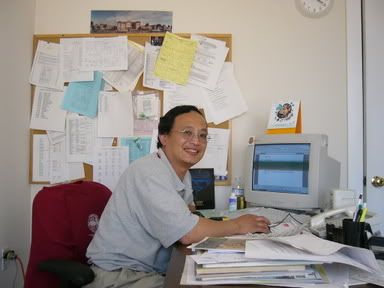
Alex at his office at Cornerstone Evangelical Baptist Church

We were introduced to Alex Sue in his office at the Cornerstone church, the first thing we noticed was a calendar with Chinese proverbs on the top of his computer. The rest of the office was filled with papers and timetables of Church activities.

Alex is a middle-aged Chinese American with a very jovial and vibrant personality and very much like a warm, fatherly figure. He came to America, from Hong Kong when he was 13 years old and has spent almost 30 years here in the Bay Area. Alex was previously an IT consultant before being retrenched during the 2001 burst of the dot.com bubble. Since then, he has been working as a church worker at the Cornerstone Evangelical Baptist Church in San Francisco. He now lives in Sunset District, another largely Chinese populated area in San Francisco.

As a teenager, Alex spent most of his time helping out at his father’s restaurant near Chinatown. At 20, his met his future wife, also an Chinese American from Hong Kong. It was then that he became a Christian and started attending the Cornerstone Baptist Church.
Having read most of the Chinese American literature on the kind of discrimination which Chinese Americans faced in America, it was interesting that Alex thought otherwise. While working as a senior IT consultant, Alex said that he rarely faced any discrimination as a Chinese American, and did not have a problem interacting with non-Asian American colleagues. When asked if he felt that his retrenchment was a result of racial bias, Alex believed that it wasn’t because the company cutback only left one other person in charge of the project and over 40 others were retrenched along with him. Although, Alex had a more varied multi-racial social circle in his previous occupation, his current job as a church worker in Cornerstone has altered his social circle. It now comprises of mainly Chinese-Americans, such as himself.

Could it be that being a Chinese American in the Bay Area is the norm rather than the exception? We also found out from Alex that Chinese festivals were widely celebrated around the Bay Area. Festivals such as Chinese New Year and the Mooncake Festivals are celebrated in schools and children are given the day off for Chinese New Year. Furthermore, Chinese New Year festivals in Chinatown are televised live on local Bay Area television stations, thus putting it on equal standing with other festive holidays such as Thanksgiving and the Fourth of July.

So how is life like for Alex as an American Chinese? Having spent 30 years in San Francisco, has this made him more a Chinese American or an American Chinese? Alex felt that he was first and foremost a Chinese, and proud of it. He feels strongly that as a parent of two teenage daughters, it is his duty to pass on his Chinese heritage and hope that they would accept them as his own. However, he also understands that they would never see things the same way as he does because they’re experience is essentially “American” and not “Chinese”. When asked if he would allow his daughters to date outside of their own race, he jokingly said that “hopefully Chinese, then maybe something else.”

At home, Alex is not only the man of the house but also the chef. He jokingly calls himself “yi jia zhi zhu”—pun on the “zhu’ (“cook” and “head”). He enjoys cooking Chinese cuisines and stresses that ‘the family must eat around the table during meal times’, rather than ‘around the television’. Does he still use his mother tongue, Cantonese, at home? He says that most of the time, he would converse with his wife in Cantonese and sometimes with his daughters. However, when we bumped into Alex and his younger daughter Jessica at a Chinese restaurant that evening, we observed that they were both conversing in English.


We also interviewed another member of the Cornerstone church, Philip. Being a 2nd generation Chinese America, Philip was more fluent in English and had a strong American accent. He has been working in Cornerstone church for over 20 years as a Media manager. He is married to a Chinese American and has two young daughters, aged 12 and 8.
(to be continued, approval pending)

------------

In Retrospect

Both Alex and Philip have very close interaction with the Chinese American Christian community and this has given them a comfortable environment in which to identify with many others such as themselves. However, being a generation apart, they share contrasting views of how they see themselves as Chinese living in America.

While Alex sees himself as a Chinese American and feels very strongly about being first and foremost a Chinese, Philip, on the other hand, sees himself as a American Chinese with no strong affinity with mainland China, yet he still feels a sense of belonging to his parent’s cultural heritage. In celebrating Chinese festivals, Alex seems to hold more importance to the event than Philip does. For Alex, the act of giving his daughters ‘lucky money’ (ang pao) and telling stories of how the mooncake festival originated helps in instilling in his children a sense of their cultural identity. However, for Philip, Chinese New Year is only celebrated with immediate family members, and not extended relatives (despite all his relatives being here in the Bay Area). He sees these festive occasions as a cultural routine adopted from his parents. Actually, although he claims that both Chinese New Year and Christmas were of similar importance, I would think that Christmas would play be of greater importance to him than Chinese New Year.

However, it is interesting to note that both seek to retain their cultural identity through language, and the practice of the language at home, especially with their children, is a conscious effort to preserve their cultural heritage.

Monday, September 04, 2006

When in Rome, do as the Romans do...

Photobucket - Video and Image Hosting
Beatrice

I was introduced to Beatrice by Janice who casually bumped into her on campus. Her mannerisms were wholly American and from our conversation with her, I could sense that it was a conscious effort on her part to assimilate into the American Culture, as opposed to Victor whom I met just that afternoon.

When asked what sort of jobs her parents held, Beatrice said that her father is a juvenile probation officer, while her mother is a kitchen designer. Beatrice herself pointed out that these were not the typical ‘Asian sort of jobs’ commonly held by most Chinese Americans. Given her atypical background, you get the sense that Beatrice isn’t your average Chinese American who feel very strongly about her cultural identity. In fact, she sees it as a non issue and believes more in assimilating into the new environment that her parents have chosen to settle into. It was through Beatrice that we came across the term ‘Fresh of the Boat’ (FOB) a nicknamed coined for Chinese Americans who refuse to assimilate into the American culture and have a strong cultural affinity to their Chinese heritage.

Steph

Below is a report by Janice on our interview with Beatrice:


Beatrice’s story

Background:


Beatrice’s dad works as a Juvenile probation officer and her mum is a kitchen and bath designer. Her parents live in Vallejo, her sister, alone in Concord, while she also lives independently in Pinole. Both her parents were living comfortably in Hong Kong but they decided to migrate to San Francisco mainly to explore the opportunities America holds for them and their children. Furthermore, Beatrice’s aunt who was already in San Francisco offered to sponsor her mum to come over. Beatrice came over when she was two years old and she’ll be going over to Hong Kong for an exchange in the spring.

On identity:

Beatrice finds it harder to identify with Asians because she has conflicting values after growing up around a very mixed environment. Having not grown up in Chinatown, she instantly accepted diversity and learned to distinguish individuals on a personal rather than a racial perceptive. Moreover her family has cut off connections with the others in Hong Kong. Hence, she only keeps in touch with her immediate and close family in the United States. Going back to Hong Kong for Beatrice would primarily be a tourist experience to learn more about the language and culture because for her, home is in Pinole (Although so close to SF, she still feels rather detached from the city.). Beatrice is aware of her indifference to the Chinese people but understands that although she does not use her race to identify herself, it is nonetheless still huge factory in her identity. Going back to Hong Kong would help her learn more of who she is, which is mainly a product of her parents. They serve as the medium in which she’ll learn of her people. She really wants to experience their youth, and although Hong Kong has gone through many transformations, the trip will give her a better understanding of their past. To restructure their lives in America was a huge sacrifice and struggle for her parents and she is very curious to see what they left behind and the influences that have shaped their current view on life. Re-establishing herself with her birthplace would also bring about greater understanding between her and other friends from Hong Kong.

She would only identify herself as a Chinese if asked but otherwise she hardly gives thought to her identity as to whether she’s American Chinese or Chinese American because most of the time she’ll introduce herself simply as Beatrice.

The Chinese in Beatrice brings out her competitiveness, the desire to achieve her ambition and display the practical side of her nature. Her American identity, however, is the creative end product after assimilating her Chinese heritage.
Beatrice introduces a new slang- FOB (fresh off the boat) which is a negative term used to describe Chinese Americans who generally don’t assimilate into the American society but rather try to retain their Chinese aura around them.

With the rise of modern China, she recognizes the economic value of being effectively bilingual and would grab the opportunity to highlight her Asian American identity as a smart career move. (Yes, to a degree. But, I feel one of my huge advantages is that although I am Asian and capable of speaking the language, I present a very different image, both in thought and physical body type. I would highlight my knowledge of the culture, but my identity would remain simply and indistinctively, Beatrice.)

On family and values:

Beatrice is very close to the family and she shares a very open relationship with her family. They can talk about almost everything and there is nothing to hide from her parents. Even if Beatrice were to find a Caucasian boyfriend, her family would not have violent objections because when they view an individual they are less bothered by his race or nationality and instead, are more interested in his personality. (However, they would still heavily caution her on the cultural conflicts that may later arise due to an inter-racial marriage.) Family plays a very influential role in Beatrice’s life because when compared to her American counterpart she feels that she consults and respect her family more.

On Food:

Beatrice enjoys Chinese food but it is not very often she gets that because both her parents are working and do not really have time to cook. (I don’t live with them, but when we get together for dinner once or twice a week, we will still have Chinese or Asian food, just not home-cooked, usually from a restaurant. On the daily basis, I am not skilled enough to cook many Asian dishes and am also away from home for most the day.) Moreover in San Francisco, there is a wide variety of good food ranging from Mexican to Italian, thus daily fanfare is not limited to Chinese food for Beatrice.

On language:

Both her parents speak Cantonese and sometimes in English to Beatrice. Most of the time, Beatrice converses in English with her sister.

On Chinatown and Chinese culture:

To Beatrice, Chinatown is just another tourist attraction and it’s mainly a ‘consumer experience’ over there. Though emotionally she might not feel much if Chinatown were to be demolished, rationally she would protest because she cannot find a legitimate reason to tear down what is a “symbolic tradition in California.”

She celebrates Chinese New year with her family but it’s mainly the immediate family. Beatrice does not listen to Chinese pop music but prefers American music and drama. Her dream is to be a singer somedayJ

Social Circle:

Beatrice has many friends and they are all of different races and nationality. She does not limit herself to Asian American friends but rather wants to interact and is open to friends whose values may differ significantly from her.


First glance at Beatrice, one is not really sure if she is a Chinese American as she has a nice golden tan and her style of dressing is that of a modern American lady. When talking to her I sense her dynamism and drive to work hard—vibes from most Chinese---yet there is something so American about Beatrice which I sort of find difficult to put a finger to. It could be the way she views certain issues or simply the manner in which she answers our questions---warm and helpful yet I can’t seem to identify with the Chinese in her. So perhaps for Beatrice, I would say she has assimilated well into the American society and for her, identity is about who she is now and where she’ll be in the future. Her past, roots and heritage is but a past, it’s a small part of her life though certain aspects like the importance of family would continue to follow her through the rest of her life.

Janice

Friday, September 01, 2006

Follow up on Photographs at UC Berkeley and some other issues

The last few days have been fruitful. We've interviewed 2 middle-aged Chinese Americans who work for the Cornerstone Evangelical Church and a few students from Berkeley. I would like to publish our interviews and observations on this blog, but I'm in the midst of getting the approval of the participants. I do hope they would agree to having their picture and a write up on our interview with them published on this blog.

Today, I met Victor on campus at the Freshers’ orientation booth at Sproul. Victor is the president of the Society of Hong Kong and Chinese Affairs (SHKCA). This association was initially formed in response to the 1989 Tiananmen Incident in Beijing. At present the association is a neutral forum for the discussion of cultural, economic, social and political issues of concern to Chinese communities in East Asia, as well as to keep abreast with the developments of Modern China.

I spent an hour talking to him about his views about the ‘hua qiao’ and he was generous in his knowledge and gave me a brief history of the ‘hua qiao’ since the earthquake in SF up to present. We conversed in Mandrin, a language that he felt more comfortable in speaking. It many ways, despite him being a 3rd generation Chinese American, he struck me as someone who was well in-tuned with his cultural heritage, much in contrast to the other Chinese American students around Berkeley who have rather thick America accents.

We couldn’t speak for long because he had to work at the ethnic library, so he will be taking me and Janice on a tour of his Chinatown SF tomorrow – he is a local resident there. I'm personally looking forward to the tour tomorrow.

In other news, Janice and I spoke to the lady who was selling the T-shirts at Telegraph Ave. We found out that she was from Shanghai and has just migrated to the Bay Area five years ago. Her husband has been here much longer than she has (about 8 years) and he is the artist behind those drawings you see on the T-shirts in the previous post. We'll talk to her more when we get one of those T-shirts for souvenirs.

Steph